In this article
A measure needs more than a memorable name. “On time,” “complete,” and “returned” sound clear until two people count the same fictional work and reach different totals. A short definition makes the disagreement visible before the number becomes a headline.
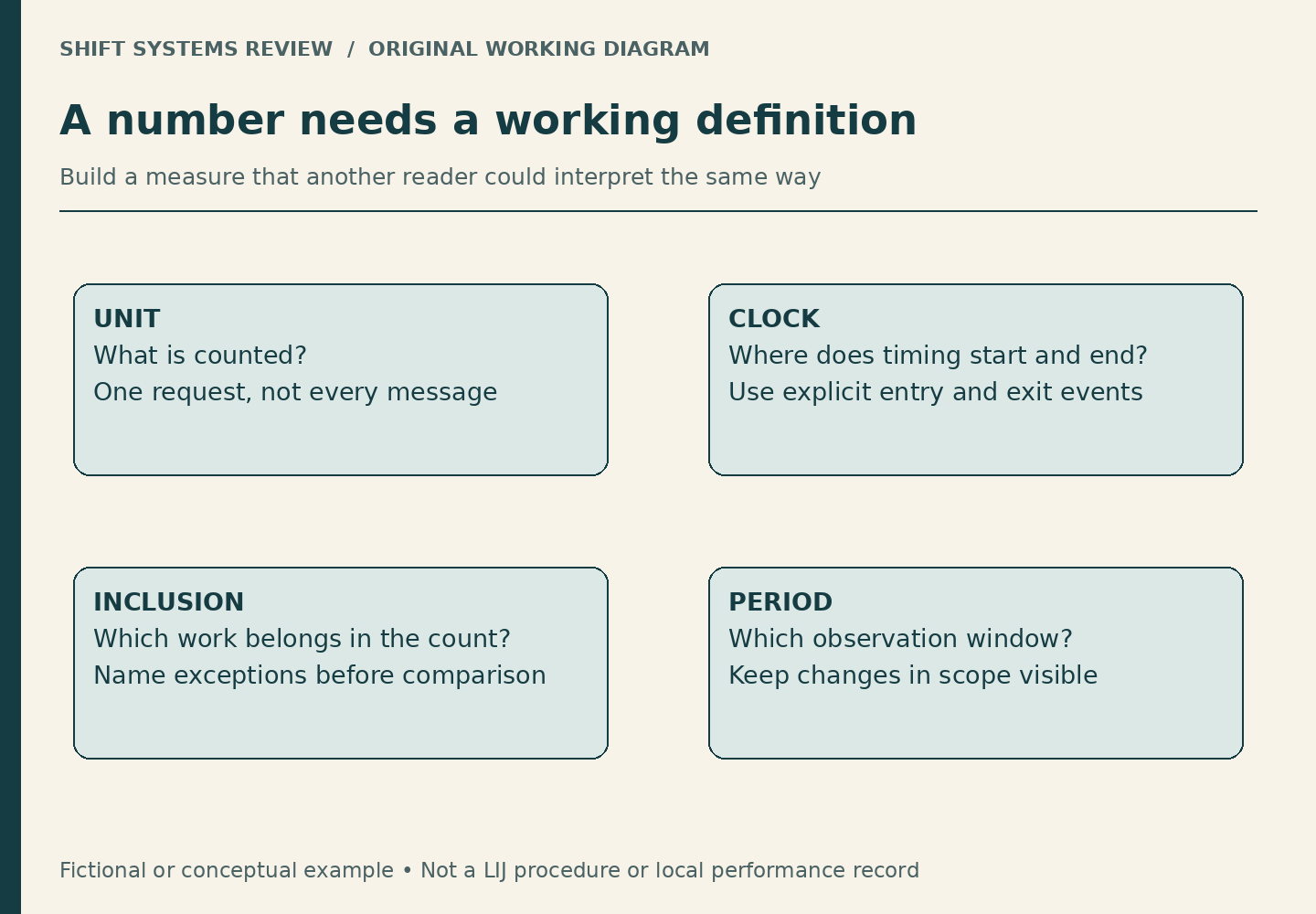
AHRQ’s Quality Indicators overview describes technical specifications that include numerator, denominator, and exclusions. Those indicators concern healthcare quality. The small specification below borrows only the discipline of defining a count; it is not an AHRQ measure, a hospital quality indicator, or an approved employer reporting template.
Build the measure around its question
Fictional example: An office prepares blank display cards for an imaginary exhibit. The question is, “What proportion of eligible card sets due this week were ready by their agreed deadline?” The unit is a requested set, even when sets contain different numbers of cards.
The numerator is the number of eligible sets due during the week that were ready by their deadline. The denominator is all eligible sets due during the week. A set still unfinished at the deadline belongs in the denominator and does not belong in the numerator. Omitting unfinished sets would make the result look better by excluding the very work the question is about.
Try the definition against awkward cases
Suppose ten sets were due. Seven were ready on time, two were late, and one remained unfinished at the end of the week. Under the stated rule, the result is seven out of ten, or 70 percent. It is not seven out of nine completed sets.
Now introduce a cancellation. If one request was formally canceled before its deadline, should it remain eligible? There is no answer hidden inside arithmetic. The measure’s purpose must determine the rule before results are compared. Whatever rule is selected must be applied consistently and the cancellation count should remain visible where it affects interpretation.
Another edge case: the deadline was changed. A result using the latest deadline may answer a different question from a result using the originally agreed deadline. Neither should silently replace the other. Label the version and explain the question it serves.
Specify time as carefully as the count
“Ready by Friday” could mean at the start of Friday, before closing time, or before midnight. A timestamp may represent clicking a status button rather than the physical set actually being available. A definition should identify the event, the clock convention, and any relevant cutoff.
For an elapsed-time measure, also decide whether the clock uses continuous time or a defined working window. Ten overnight hours and ten open-office hours are not interchangeable. Changing between them can create a dramatic apparent improvement without a single item moving sooner.
Missing is not zero
If the fictional readiness time is missing, do not quietly enter zero minutes or assume success. A missing value is an evidence limitation. The appropriate treatment depends on the agreed specification, but the number of missing or unclassifiable items needs to be visible to anyone interpreting the result.
For example, “Seven of ten were documented on time, with one item’s timing unknown” is more informative than an unexplained 70 percent. It separates what the evidence establishes from what is uncertain. An authorized reporting process may prescribe a different presentation; follow that process rather than improvising a parallel record.
A compact definition card
- Question: What decision or learning will this measure support?
- Unit: One item, one request, or one occurrence?
- Events: What exactly starts, finishes, or qualifies the item?
- Eligibility: What enters the count, and what is excluded?
- Exceptions: How are repeats, cancellations, and missing values handled?
- Version: Which definition applies to which period?
These prompts are for fictional practice or discussion with an authorized measure owner. They are not instructions to copy patient or employee records into a personal worksheet. Good definitions reduce ambiguity; they do not create permission to access or reuse data.
Evidence note: The AHRQ overview’s specification description was verified through its public search-index text on October 8, 2026; direct page extraction did not provide readable body text. No technical indicator specification was reviewed or reproduced. All card-set examples and definition prompts are original editorial material.