In this article
A test can involve one sheet of paper and still cross an important boundary. Size describes how much happens; permission describes what may happen at all. Calling an idea a pilot, a quick trial, or a PDSA cycle does not answer who can approve it, which systems it can touch, or when it must stop.
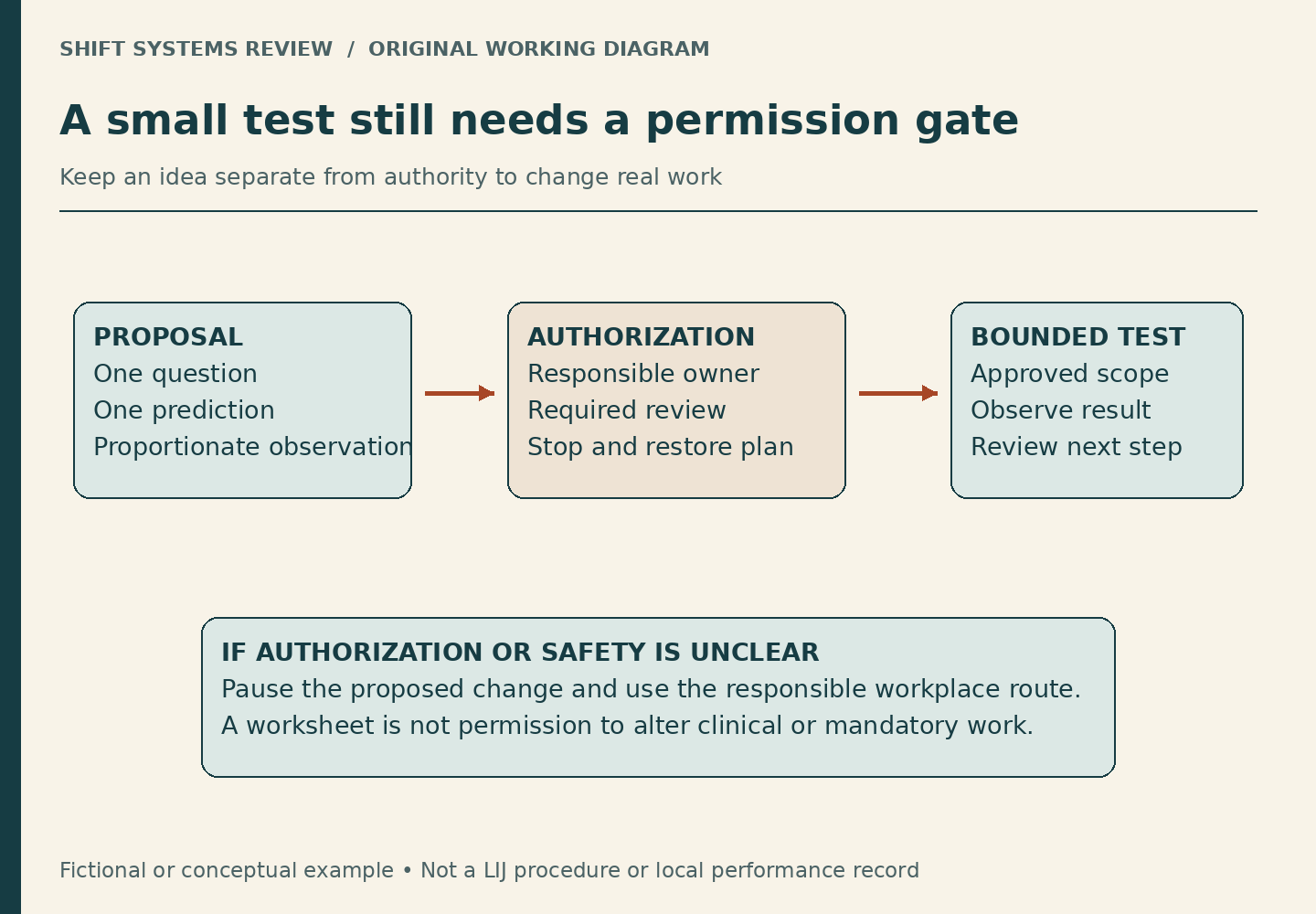
The Institute for Healthcare Improvement describes PDSA as repeated learning through planning, trying a change, studying results against predictions, and deciding how to adapt. It encourages small early tests. That method is described in IHI’s Testing Changes guidance; it does not supply permission for a reader’s workplace.
The exercise below is this publication’s original, fictional application. Use invented paper materials at a desk, with no real requests, records, names, live systems, or operational supplies. It does not authorize an operational test at LIJ, Northwell, or another organization. Clinical work, safety controls, staffing decisions, and protected information remain outside this exercise.
Start with a test that cannot quietly become work
Imagine a fictional office packet containing three blank divider cards, a cover sheet, and a paper clip. An invented packing diagram shows the order. The question is whether numbering the positions on the diagram makes the packet easier to assemble correctly. Nothing will be distributed, ordered, or used by a real department.
Keep the exercise visibly separate from work: mark every page “FICTIONAL DESKTOP EXERCISE,” use made-up item labels, and keep the materials off operational surfaces. The separation matters because an attractive prototype can be mistaken for an approved instruction. A clear label reduces that ambiguity; it is not a substitute for approval.
Write the permission box before the prediction
On a blank sheet, answer four questions about this invented exercise:
- Allowed action: Rearrange only the numbered positions on the fictional packing diagram.
- Excluded action: Do not change real stock locations, ordering rules, departmental forms, task assignments, or any live instruction.
- End point: Stop after comparing two invented diagram versions with the same fictional packet.
- Stop condition: Stop sooner if completing the exercise would require real workplace information, another person’s participation without permission, or access to a live system.
In an actual authorized project, the appropriate local owner would determine the permitted scope and any required reviews. A colleague’s enthusiasm, access to a shared folder, or a previous test in another area would not establish those permissions. When permission is unclear, the next step is clarification through the local route, not a smaller unauthorized experiment.
Make the prediction capable of being wrong
A weak prediction says the numbered version will be better. A useful fictional prediction says that its sequence will be understandable without checking a separate legend. This creates a specific question the paper exercise can challenge. If the numbers help only because you already remember the original diagram, the exercise has not answered the question.
Keep the comparison modest. Use one unchanged set of invented materials and inspect whether each version explicitly identifies the same positions. Do not time colleagues or gather workforce performance data. For this desktop exercise, a written list of ambiguous instructions is sufficient. The aim is to practice test design, not produce a claim about productivity.
Decide what the result can support
Suppose the numbered diagram resolves the order but leaves the cover sheet orientation unclear. A reasonable conclusion is that the prototype needs an orientation cue. It is not evidence that a department will work faster, that errors will fall, or that the new diagram should replace anything in use.
Write the next decision in the same narrow terms: revise the fictional orientation cue, abandon the numbering idea, or retain the prototype for a future permission discussion. Link the decision to what the exercise revealed. Avoid treating effort already invested as a reason to keep an idea that did not answer the question.
Check the edge again before any next cycle
The most important boundary can appear after an encouraging result. Adding a second location, involving another role, using a live form, or extending the duration changes the proposed activity. Each expansion needs its own scope check. The word “next” does not carry approval forward automatically.
For a clearer starting question, read Choose an Improvement Question Before Choosing a Fix. Before describing wider effects, use the balancing-measures guide. A well-bounded test leaves behind a small, defensible learning statement and a clear next decision, rather than an unofficial new way of working.