In this article
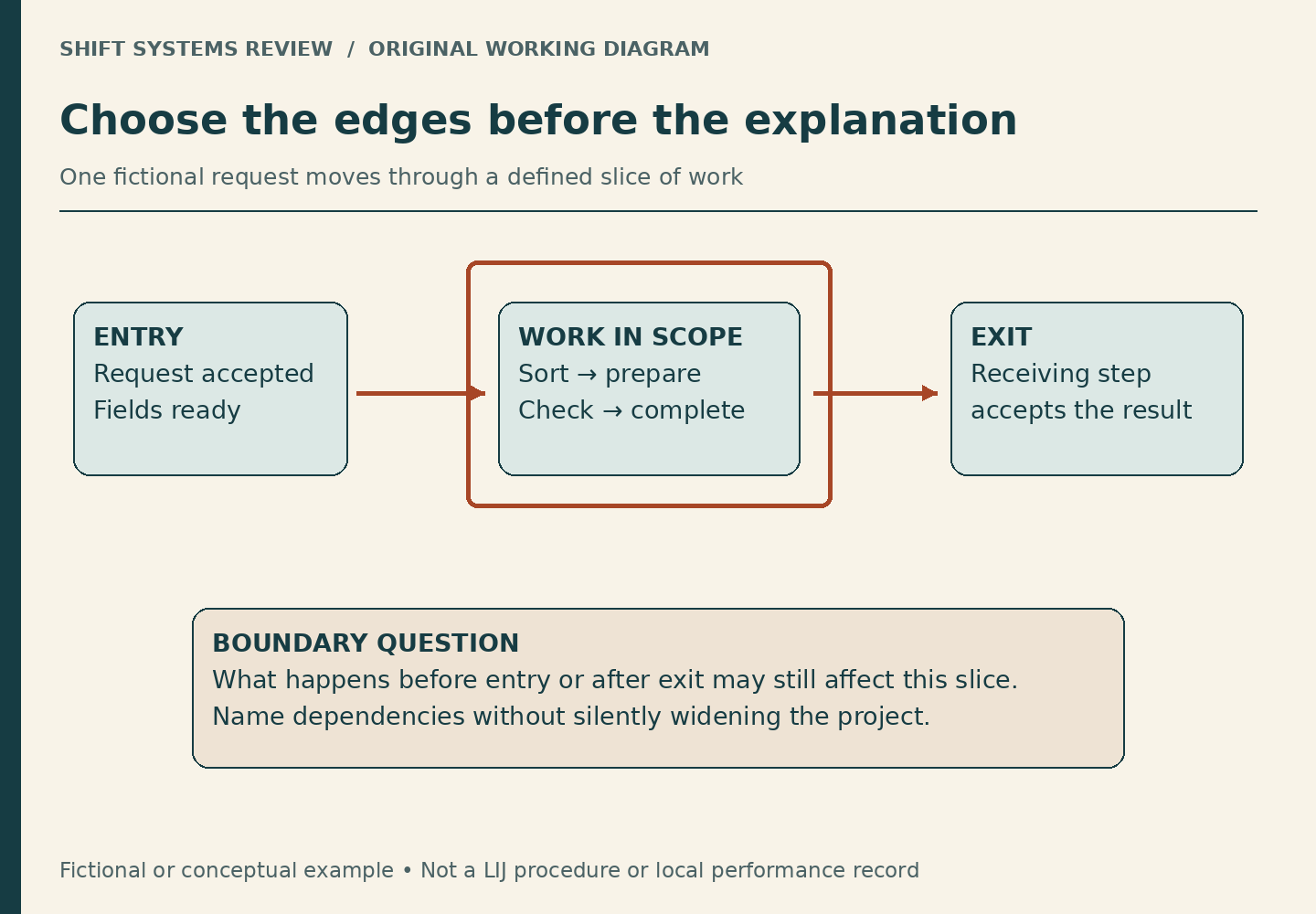
A workflow can appear slow because it is slow, because its starting point is unclear, or because people are describing different pieces of it. Before proposing a fix, decide what journey you mean. A useful boundary has an observable beginning, an observable ending, and one recognizable unit moving between them.
For readers who arrived through “lij my experience,” this publication uses LIJ to mean Long Island Jewish Medical Center in the Northwell context. Northwell’s public careers page names the medical center and refers to a career resource on myExperience. That limited public connection does not make this an employee-system guide or an account of Northwell’s improvement practices.
Start with one item, not a department
Fictional desk exercise: An office prepares blank welcome folders for an imaginary public lecture. A folder starts as an assembly request and ends as a checked packet on a pickup shelf. There are no attendee names or hospital records. Someone says, “Folder preparation takes too long.” That sentence could mean three very different things:
- How long does one person spend assembling a folder?
- How long does a request wait before assembly begins?
- How long until the whole requested set is available?
Each question can be valid. Each needs a different boundary. If the concern is readiness for pickup, measuring only assembly will exclude the wait that matters. If the concern is awkward folding, a start-to-pickup measure may conceal the small physical task under a much longer queue.
Make both ends recognizable
“When the work arrives” is not yet a definition. In this example, does arrival mean a request was drafted, sent, received, or accepted as complete? Choose one event and explain why. Likewise, “finished” might mean assembled, checked, shelved, or collected. Write the endpoints as events another reader could recognize in the same fictional sequence.
A workable exercise boundary is: “From acceptance of a complete request for ten blank folders to placement of all ten checked folders on the pickup shelf.” The unit is the request for ten, not each folder. That choice matters: nine ready folders do not finish the request. For a different question, individual folders might be the better unit.
Keep exclusions visible
Every boundary leaves something outside. Name those exclusions so a tidy result does not become a sweeping claim. Our exercise excludes buying materials, designing the handout, lecture delivery, and the requester’s travel to collect the folders. It includes time waiting between assembly and checking.
Now imagine assembly gets faster but the checker receives a larger pile at once. The assembly result could be real while total readiness barely changes. A boundary statement should therefore name the adjacent work that might absorb a burden, even when that work is not inside the main measure. That is the bridge to a balancing measure.
Separate a viewing boundary from a permission boundary
You may need to understand an upstream dependency without having authority to change it. A map can acknowledge “approved content supplied here” without proposing to remove content approval. In a real workplace, responsibility, data access, and permission to test changes require the appropriate local owner. Reading this article grants none of those permissions.
For practice, stay with invented materials. Do not watch coworkers, export a work queue, photograph a screen, or create a private timing record to complete this exercise. If a real improvement question warrants investigation, the next action is to clarify its authorized scope and approved evidence source with the responsible team.
A boundary you can defend
Finish with four sentences: “We are studying this unit. The clock starts here. The clock ends here. These neighboring activities remain outside, but could be affected.” Then ask whether the proposed result would answer the original concern. If not, change the boundary before changing the work.
Source scope: AHRQ’s Workflow Assessment for Health IT Toolkit recognizes both clinical and administrative workflow and is aimed at ambulatory health IT work. The folder exercise, boundary questions, and permission distinctions here are original editorial applications, not an AHRQ procedure or an LIJ policy. Public source text checked October 8, 2026.