In this article
A process map is most useful when it reveals something a list of job titles cannot. The interesting parts are often the spaces between obvious activities: an item waiting, a missing input, a decision with two exits, or a return to a step everyone thought was complete.
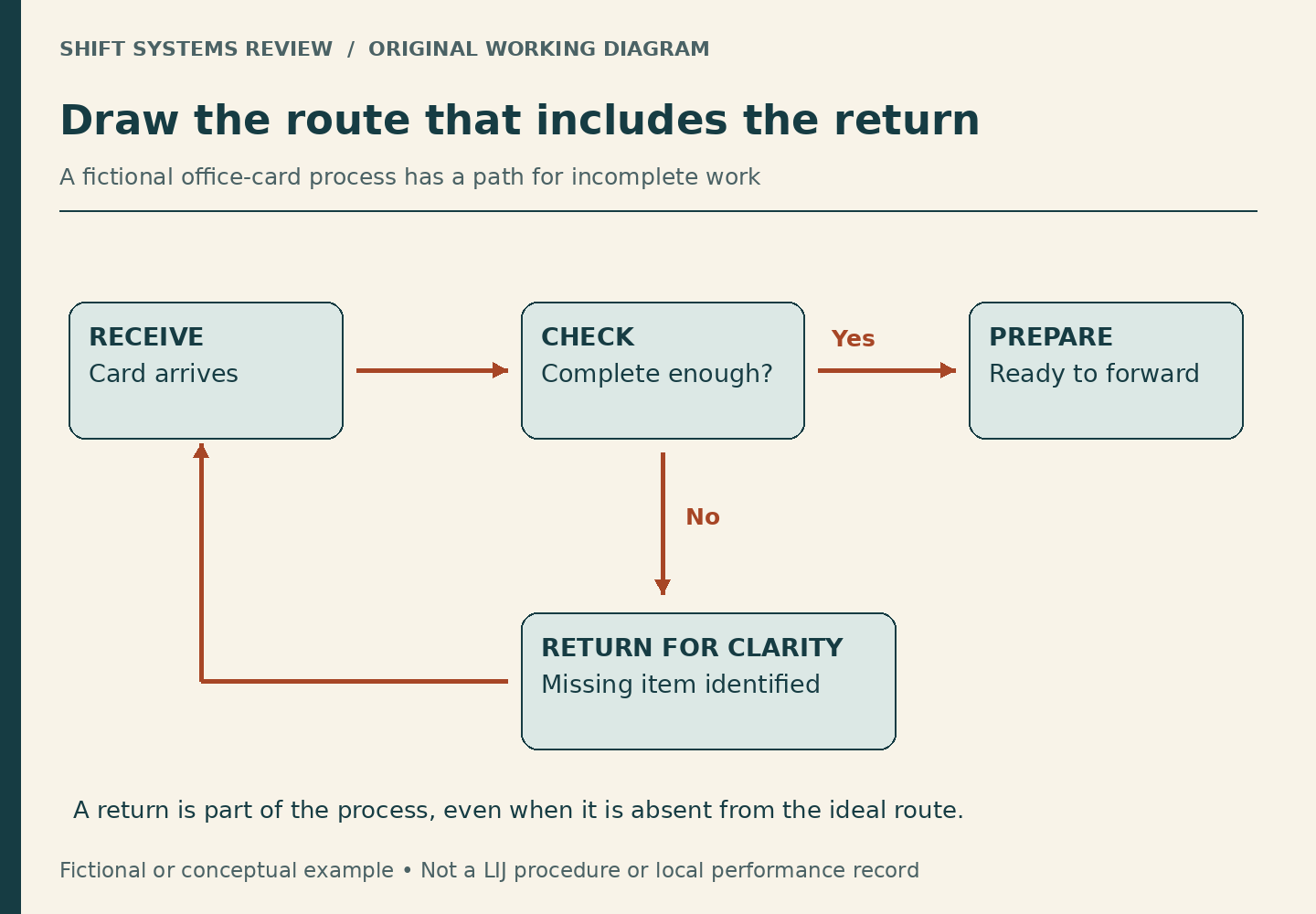
AHRQ’s Flowchart resource describes a way to show process steps, responsible groups, and handoffs, then validate the map with people who know the work. Its setting is healthcare workflow assessment. This article’s invented office map is a literacy exercise, not a map of any Northwell department.
Begin with a plain sentence
Fictional example: A small office produces generic shelf labels for a display of donated books. The unit is a request for one set of labels. The start is receipt of a complete request; the finish is a checked set ready for installation. No real locations, names, or operational labels are used.
The first description sounds straightforward: receive the request, prepare the labels, check them, finish. It is a reasonable outline. It is not yet enough to explain delay or repeated work. Expand only the part relevant to the question. If sets frequently return from checking, the choice after that check deserves detail; the exact sequence of opening a blank file probably does not.
Use verbs that expose a change
“Administration” is a location or function. “Confirm the requested label size” is an action. “Pending” is a state. “Wait for the approved size” explains why the item is not advancing. Write each step so the item’s situation before and after it is understandable.
For this exercise, the fuller path is: receive request; determine whether size is specified; return incomplete request or accept it; prepare labels; wait for checking; compare against request; correct mismatch or mark set ready. Notice that “incomplete request” appears before the defined start. It can be shown as context without secretly adding that time to the measure.
Draw both exits from a decision
A decision written as “Check labels” can hide a failure route. Phrase the decision as a question: “Does the prepared set match the accepted request?” Then show both the yes path and the no path. The no path should lead somewhere specific. “Fix it” is less helpful than “Return to preparation with the mismatch identified.”
Do not invent a single route when several remain uncertain. An honest question mark is useful: “Does correction return to the same preparer or to a shared queue?” Resolve that through an authorized process review, not by choosing the cleaner-looking arrow. The map is a claim about work, and claims can be incomplete.
Show waiting without treating it as wrongdoing
Between preparing and checking, the fictional labels may sit until a scheduled review period. Label that wait. Its presence does not prove it should disappear. The review arrangement might serve a legitimate purpose that the map does not explain. A visual gap identifies a question; it does not answer the question of value.
Similarly, two checks do not automatically establish duplication. They might check different properties or protect against different errors. The next useful question is what each check decides and what would be lost if it were removed. Removing a safeguard is outside this exercise.
Keep the present and the proposed apart
Do not quietly replace an awkward current route with the route you wish existed. Label one map “fictional current sequence” and a second “proposed sequence for discussion.” A combined picture can make a suggestion look like an established practice and prevent a reader from understanding the starting point.
Finally, walk one invented request through every branch. Can it enter, wait, return, and finish without disappearing? Does a correction produce a second completion count? Is “ready” different from “collected”? These questions test the logic of the map before any numbers are added.
Use the map carefully: This exercise uses fictional objects only. Actual workplace observation, records, and process changes require the relevant owner’s authorization and approved methods. A finished drawing is not approval to redesign work. Next, use handoff measurement to distinguish movement across a boundary from acceptance at the next step.