In this article
An item can be finished at one step and still be far from finished overall. It may wait for a batch to fill, a transfer time to arrive, or the next step to become available. Those intervals belong to the item’s journey even when nobody is actively working on it.
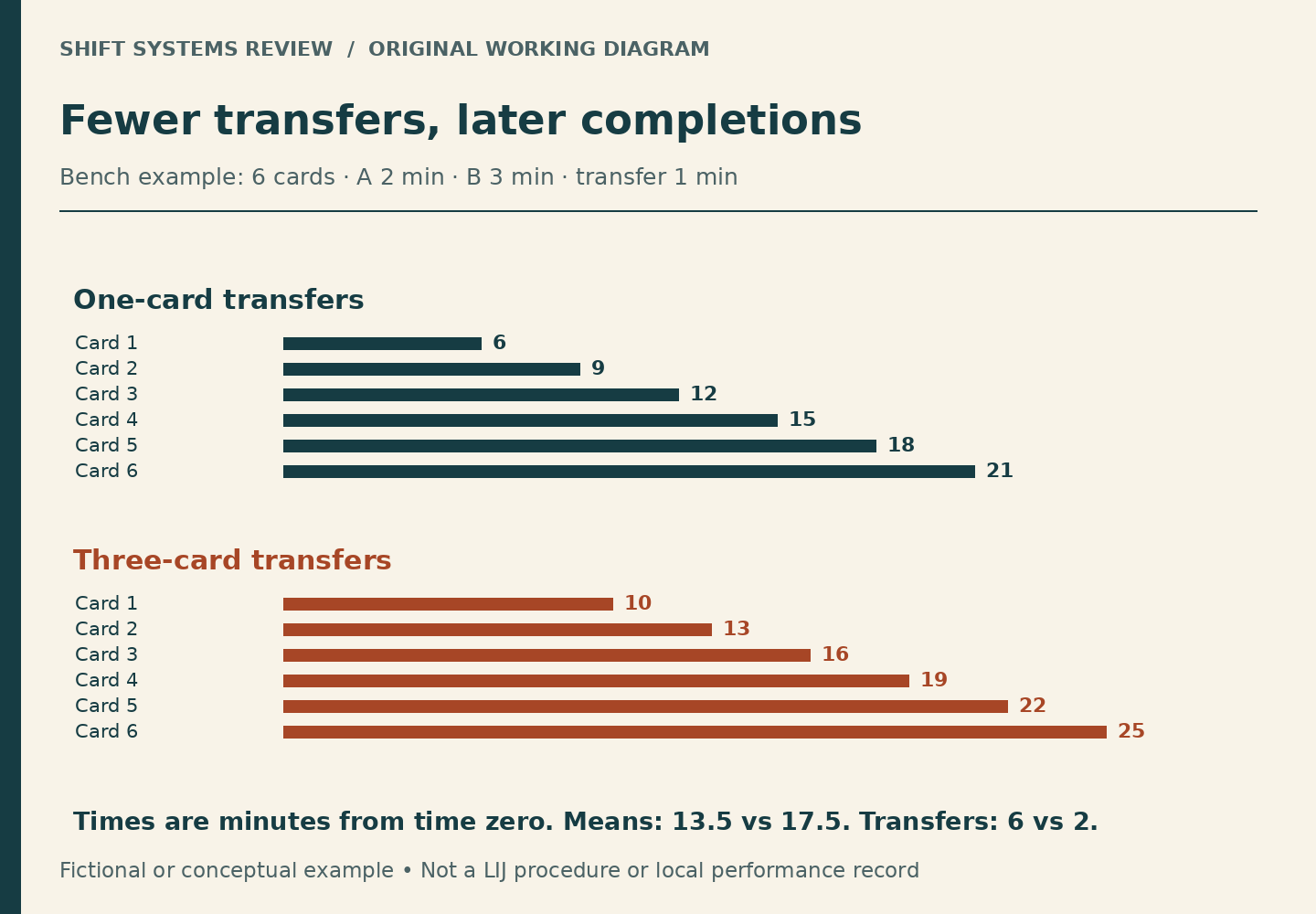
The Batch-and-Flow Bench on our home page makes one narrow part of that journey visible. It compares fictional paper cards moving through two stages. It is a deterministic teaching model with stated assumptions. It is not a staffing calculator, a hospital forecast, or a recommendation about clinical work.
A six-card thought experiment
Fictional example: All six blank cards are available at time zero. Stage A marks each card in one minute. Stage B checks each card in one minute. Each stage handles one card at a time; the stages may work simultaneously on different cards. Transfers take no time. There are no mistakes, breaks, priorities, setup costs, or other work.
With a transfer batch of six, Stage B waits until Stage A has marked all six cards at minute six. The first card completes at minute seven; the last completes at minute twelve. The six completion times are seven through twelve minutes, giving a mean elapsed time of 9.5 minutes from time zero.
With a transfer batch of one, Stage B receives the first marked card at minute one and finishes it at minute two. The final card finishes at minute seven. Completion times are two through seven minutes, with a mean elapsed time of 4.5 minutes. Neither marking nor checking became faster. The difference came from when work could move.
Be precise about what became smaller
A transfer batch is the number of items moved together. A production batch can mean the number made before a setup or task changes. The simple example changes the transfer rule while holding per-card work constant. It does not model the cost of switching between different products, walking between rooms, or protecting materials during transfer.
“Small batches are always better” would therefore be a conclusion the example cannot support. If every transfer took several minutes, or if a legitimate check required the full set, the comparison would need different assumptions. A model is useful because it makes a mechanism visible; it becomes misleading when its omissions are forgotten.
Read three results, not one
- First completion asks when the earliest usable item finishes
- All completion asks when the entire set is done
- Mean elapsed time averages how long the individual cards spend in the modeled journey
These measures answer different questions. A requester who needs all six cards together may care most about the last completion. A requester who can use each card as it arrives may value earlier individual completions. Neither perspective is automatically correct for a real process; the unit of need must be understood first.
Also keep labor effort separate. Both versions contain twelve minutes of direct card work across the two stages. Finishing the set five minutes earlier does not mean five labor minutes were saved. Overlapping tasks reduces calendar duration without necessarily reducing the total effort required.
Try a prediction before changing the controls
In the Bench, keep the card count and stage times fixed. Predict which result will change when you adjust only the transfer batch. Then compare the result with your prediction. Next, make Stage B slower and ask whether the transfer rule still explains as much of the total duration. This is an exercise in reading assumptions, not in selecting a workplace batch size.
For real work, moving items sooner could change interruption frequency, handling effort, space needs, or error exposure. Those effects belong in an authorized review before a change is tested. Do not enter actual staff, patient, or departmental data into this teaching tool.
Source and limits: IHI’s Selecting Changes page includes waiting and workflow among areas to examine when developing improvement ideas. The numbers, assumptions, and batching demonstration above are original editorial calculations, not IHI findings or Northwell results. Public source text checked October 8, 2026.