In this article
Consider two invented methods for assembling blank meeting-room stationery packs. In the first, one fictional role receives a complete paper list and prepares the packs together. In the second, each addition arrives separately, so the first pack can be started sooner. The second method looks faster if the only clock ends when assembly begins. It may look very different when the whole sequence is considered.
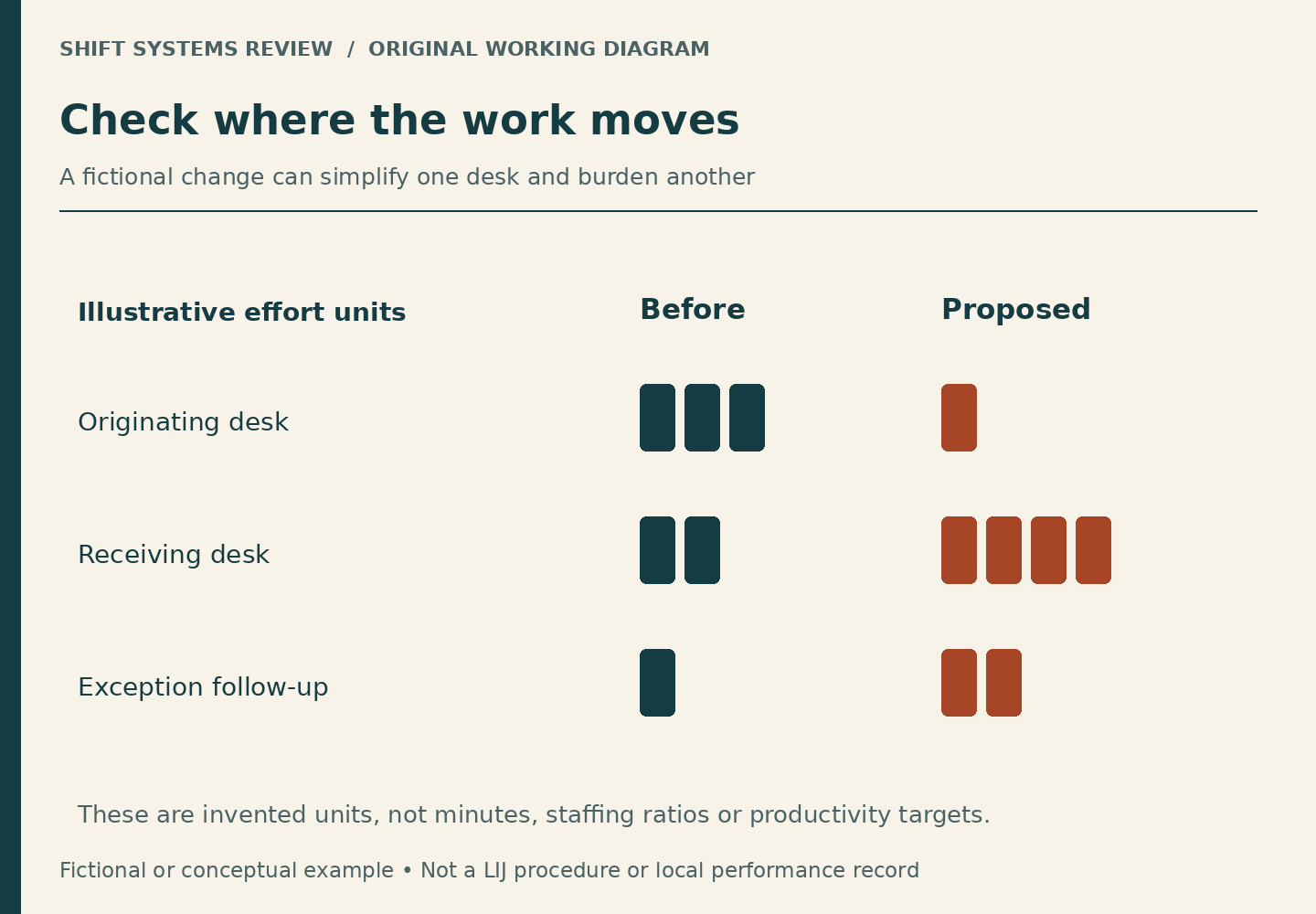
This is a desktop reasoning exercise, not a description of any hospital department. Do not observe, time, score, or survey employees for it. Use only invented roles, blank materials, and made-up sequences. Any real workflow assessment requires the appropriate local authority and approved methods; this article provides neither.
Compare two complete stories
Write the fictional first sequence as a short narrative: a complete list arrives; the assembler checks it once; materials are gathered; packs are assembled; an invented completion slip is filed. Then write the second: a partial list arrives; materials are gathered; another item arrives; the assembler checks which packs have already been started; a third message corrects the quantity; the packs are reconciled against the final list.
The second story may have less initial waiting and more coordination. That is a useful hypothesis, not a measured conclusion. It identifies where a proposed benefit might be offset. Both stories must use the same fictional end point: a complete, checked set of packs. Otherwise, the apparent comparison rewards whichever method stops counting sooner.
AHRQ’s Workflow Assessment for Health IT Toolkit emphasizes that technology can affect both administrative and clinical workflow; its stated audience is ambulatory care. The broader comparison below is our editorial application, not an AHRQ instrument or a claim about hospital performance.
Put effort where it lands
Draw four columns on an exercise sheet: preparation, main task, coordination, and cleanup. Place each invented action in one column. Rechecking the final list belongs somewhere even if the proposed change calls it a quick confirmation. Walking back mentally through completed work is still part of the sequence, even when no new pack is produced.
Next, assign each action to an invented role such as requester, assembler, or receiver. A change that removes a requester’s preparation step may add several assembler checks. Adding all the steps together reveals one kind of burden; showing their distribution reveals another. A small total increase concentrated on the busiest fictional role could matter more than a larger increase placed elsewhere.
Do not turn this paper map into a claim about actual staffing, capability, or effort. Its purpose is to expose questions that a locally authorized project would need to resolve. It cannot justify changing assignments, comparing individual workers, or removing a check that exists for a reason not represented in the exercise.
Look for the work between visible actions
- Resumption: After an invented interruption, what must the assembler reconstruct before continuing?
- Memory: Does a method require remembering which version or quantity was current?
- Coordination: Who must resolve contradictory instructions, and does that create another dependency?
- Exceptions: When a made-up item is missing, does the method offer a clear branch or merely postpone the difficulty?
These questions help distinguish a shorter action list from a simpler process. One instruction that says “resolve discrepancies” can conceal more effort than several explicit steps. Conversely, a longer checklist might remove uncertainty. Counting lines alone cannot tell which design asks more of the person carrying it out.
Challenge the attractive version
Give each invented method the same awkward condition: a late addition arrives after half the paper packs are complete. Work through the consequences on paper. Which earlier decisions must be revisited? Does the method make the affected packs identifiable, or must every pack be reopened? Do not build an extreme scenario solely to make a preferred design win.
Then remove the late addition and repeat the reasoning. A design can handle exceptions well while adding unnecessary effort to every ordinary case. The exercise should leave both strengths and disadvantages visible. For the distinction between intended improvement and side effects, read the balancing-measures guide.
End with a qualified conclusion
A useful conclusion is: “In this invented sequence, earlier starts require more version checks and concentrate reconciliation with the assembler.” An unsupported conclusion is: “The new process saves staff time.” The first says what the desktop exercise actually established and points toward the unanswered question.
Before considering a fix, use the process-map guide to keep the full beginning and end visible. Improvement literacy includes noticing when work has moved, when it has become less visible, and when a faster-looking step has simply passed its burden to the next role.